
Today's culture versus the culture you want.
Measure where your organisation stands, per team, department and location. Compare it with the direction management wants. Then act on the gap, and measure again.
Illustrative data. A wide band means management does not yet agree with itself.
Everyone has a picture of the culture.
Nobody has the same one.
Management is divided among itself
Five managers, five ideas of where the organisation should go. The strategy says one thing. The corridors say another.
Sites drift apart
Head office and the plant. The old team and the new one. Same company, different ways of leading, deciding and communicating. Nobody measures the distance.
Surveys measure satisfaction
An engagement score tells you how people feel. It does not tell you how the organisation works, or where it is moving away from what management wants.
Three questions.
One measurement.
Where are we today?
Employees describe the culture as it is. Per team, department and location, so you see the differences inside the organisation.
Where do we want to go?
Management describes the desired culture. The report shows the average, and how far managers are apart. Alignment at the top comes first.
Did anything change?
Measure again after a workshop, a reorganisation or a new leader. Log what happened in between. See whether the gap moved.
From gap to action to follow-up.
Real reports, filled with demo data from a fictional company.
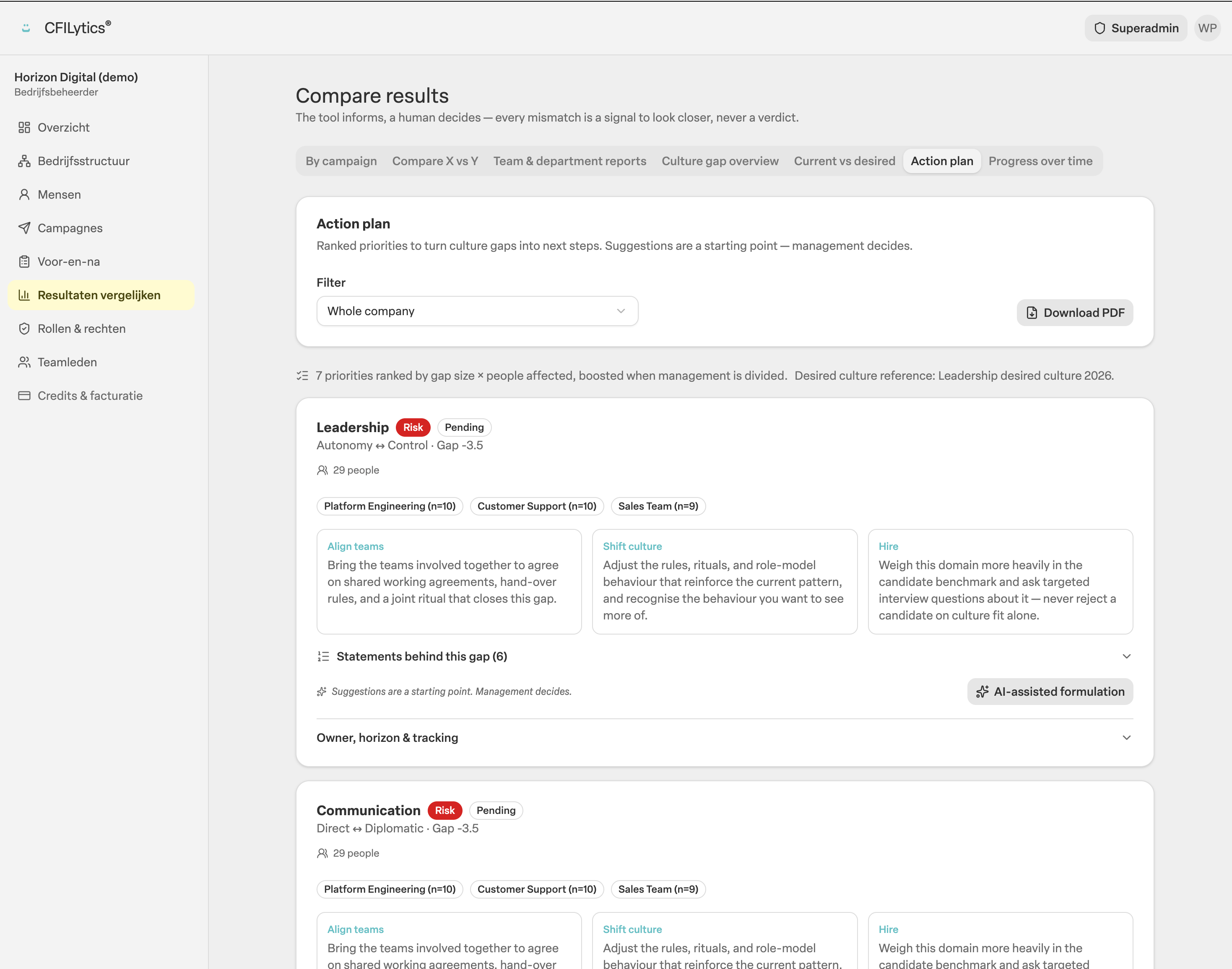
Priorities, not a wall of data.
Every domain with a gap becomes a priority, ranked by the size of the gap and the number of people affected. It moves up when management is divided.
Each priority offers three routes: align teams, shift culture, or weigh it in hiring. You assign an owner and a horizon. Management decides.
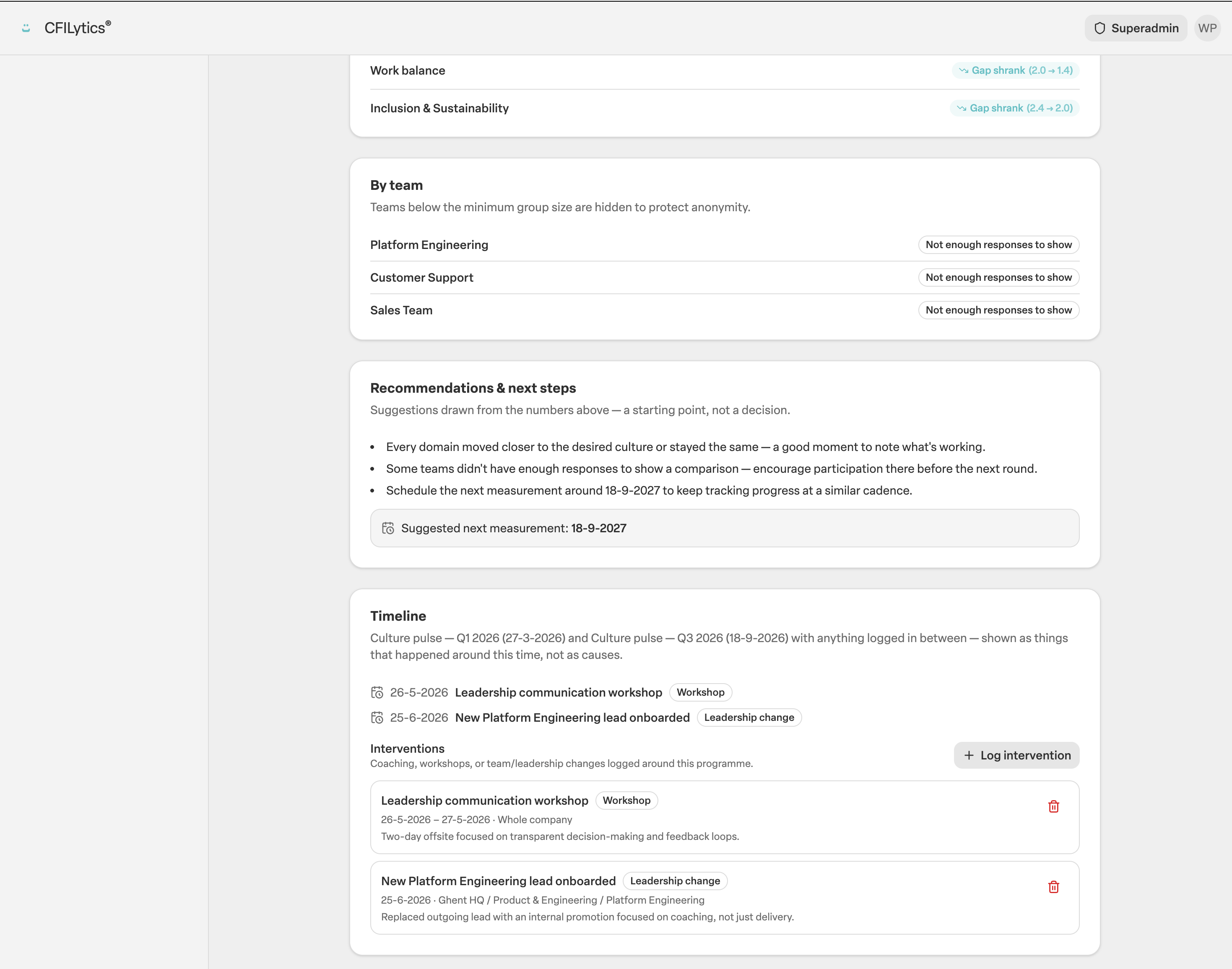
Two measurements, side by side.
Log workshops, coaching and leadership changes on a timeline. The next measurement shows per domain whether the gap shrank, grew or stayed.
Shown as things that happened around the same time, not as proven causes. That honesty is the point.
Honest answers need a safe measurement.
You decide per campaign whether employees answer anonymously or by name. For a culture measurement, anonymous is the default.
- Group results from 5 respondents. Smaller teams are shown at the next level up. Nobody can be singled out.
- Team versus team, site versus site. Every group is measured on the same scale, so differences are real differences.
- Managers see their own scope. Rights per team, department and location. Roles are set in the app.
- Every participant gets something back. A personal insight report, so the measurement is not a one-way street.
Method, not magic.
Leadership teams need a measurement they can put on the table, not an opinion with a chart.
Based on Edgar Schein's basic underlying assumptions. Developed with Sapience, a spin-off of the Vrije Universiteit Brussel (VUB). Described in the book De Architectuur van Bedrijfscultuur (Pelgrims & Desmet, 2026).


- Deterministic scoring. The same answers always give the same result. No black box.
- Distance, not labels. Profiles are compared with Euclidean distance over all statements. Nothing is left out.
- Anonymous when you want it. You choose per campaign. Anonymous group results appear from 5 respondents.
- No automated decisions. The tool informs. A person decides.
- GDPR and EU AI Act. Candidate data is kept for 365 days.
Three steps, then again next year.
Set up your structure
Locations, departments, teams. Invite employees and management from the app. Each person gets a link to an 8-minute chat.
Read the gap
Current versus desired, per domain and per group. The action plan tells you where to start and who is affected.
Act, log, measure again
Run the workshop, change the ritual, hire for the gap. Log it. Measure again and see what moved.
Start free. Then pay for what you measure.
A culture measurement is priced per campaign, not per employee. All reports included.
10 measurements free
One measurement is one completed questionnaire. No card needed.
Start freePer candidate
Compare a candidate with the team, or with the culture you want. Priced per candidate.
See pricingPer campaign
Employees, management or both. All reports included. Priced per campaign, not per person.
See pricingBefore you start.
How many people do we need?
Can we measure only one department first?
Who sees what?
How often should we measure?
Start with one team.
Your first 10 measurements are free. See your first gap this month.