Measure culture before it costs you.
Culture fit and culture gap on seven domains. The tool informs, a person decides.



Culture is decided on gut feeling.
Everyone agrees culture matters.
Almost nobody measures it before a decision.
The signal comes too late
Cultural mismatch shows up late. After the merger. After the hire. After the reorganisation. By then the cost is already made.
Surveys measure satisfaction, not culture
An engagement score tells you how people feel. It does not tell you how the organisation leads, decides, communicates and handles risk.
Two cultures, no common scale
A buyer and the company it acquires. A head office and its branches. A candidate and the team. Everyone feels the difference. Nobody can say where it sits, or how large it is. Without one scale, that stays an opinion.
One scale.
Seven domains.
Two poles each.
CFILytics® measures it first, on seven domains. It shows the culture fit, and the culture gap with the culture you want, so you can act on it: in leadership, in teams, and in hiring.
Every domain is a scale between two ways of working. What matters is the distance between two profiles.
Leadership
Autonomy ↔ Control
How much steering is wanted?
Communication
Direct ↔ Diplomatic
How honest may feedback be?
Collaboration
Individual ↔ Collective
Who gets the credit?
Innovation
Risk ↔ Stability
How do we handle change and risk?
Engagement
Intrinsic ↔ Extrinsic
Why do we get out of bed?
Work balance
Integration ↔ Segmentation
Where does work stop?
Inclusion & Sustainability
Pragmatic ↔ Values-driven
Are our values leading, or marketing?
See the gap. Then hire for it.
Culture fit tells you who resembles the team. The culture gap tells you what the team is missing.
-
Find the domain with the largest gap
Compare today's culture with the culture management wants. The report ranks the seven domains by distance.
-
Weight that domain in the candidate benchmark
Give it more weight in the comparison. All statements and all domains stay in.
-
Look for people who bring what is missing
Candidates are ranked by distance to the desired profile, not to the team as it is. Ask targeted interview questions on that domain. So you hire towards the culture you want, without cloning the team you have.
A candidate's result is input for the conversation. Never a reason to reject.
Match with the desired culture, Communication weighted double. Illustrative data.
One statement. Three perspectives.
Each statement is worded three ways. So you always compare like with like.
“My ideal organisation…”
What a candidate is looking for in a workplace.
Compared with the team the candidate would join. Every candidate receives a personal insight report in return.
“My organisation…”
The culture as it is today. Per team, department and location.
You choose per campaign: anonymous or by name. Anonymous group results appear from 5 respondents.
“My organisation in the future…”
The culture management wants to build.
The reference point for every gap in the organisation.
What you see after a measurement.
Real reports from the application, filled with demo data from a fictional company.
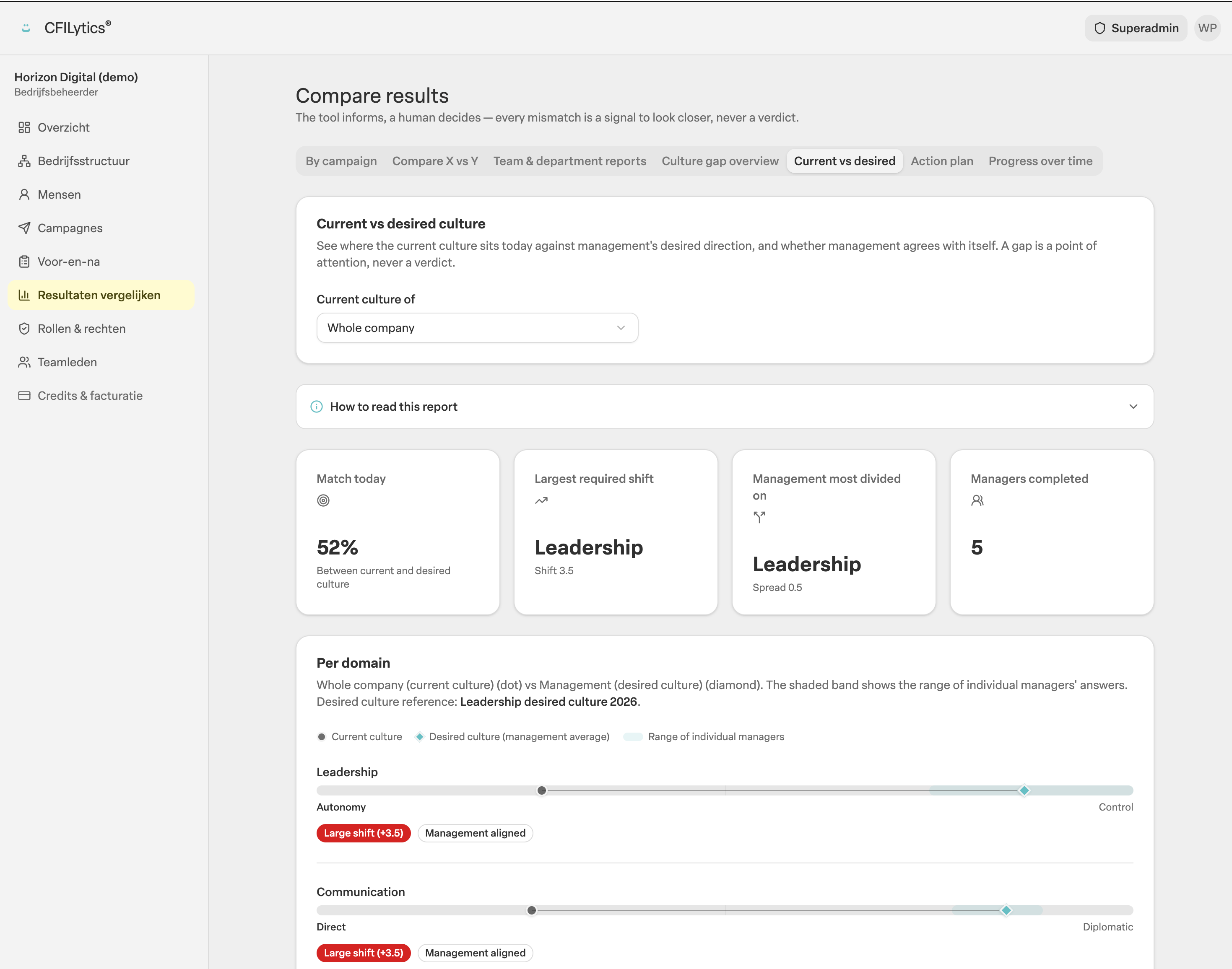
Where you are. Where you want to go.
The dot shows today's culture. The diamond shows management's average for the desired culture.
The shaded band shows how far individual managers are apart. A wide band means management does not yet agree with itself.
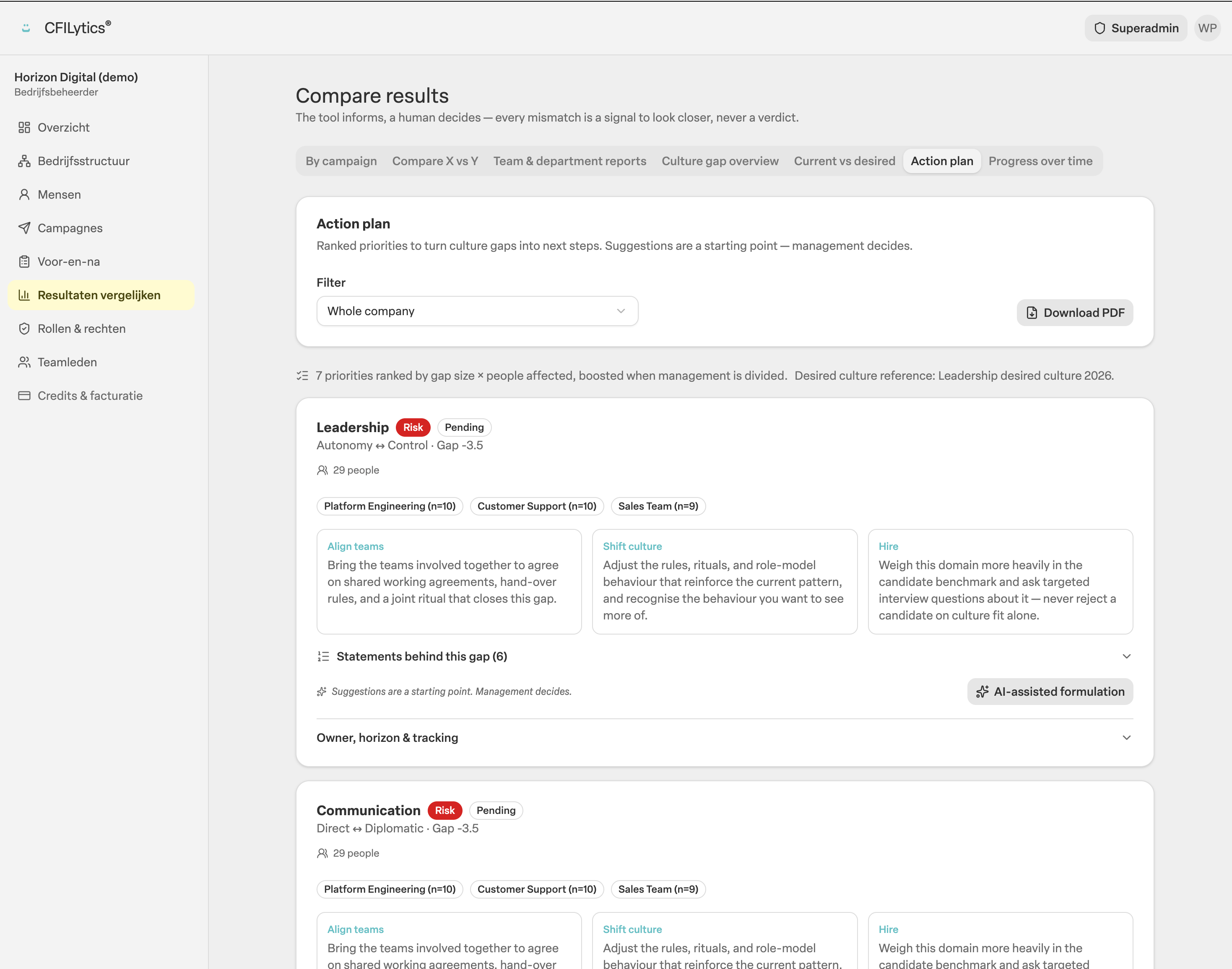
From gap to next step.
Priorities are ranked by the size of the gap and the number of people affected. They move up when management is divided.
Each priority offers three routes: align teams, shift culture, or weigh it in hiring. Management decides.
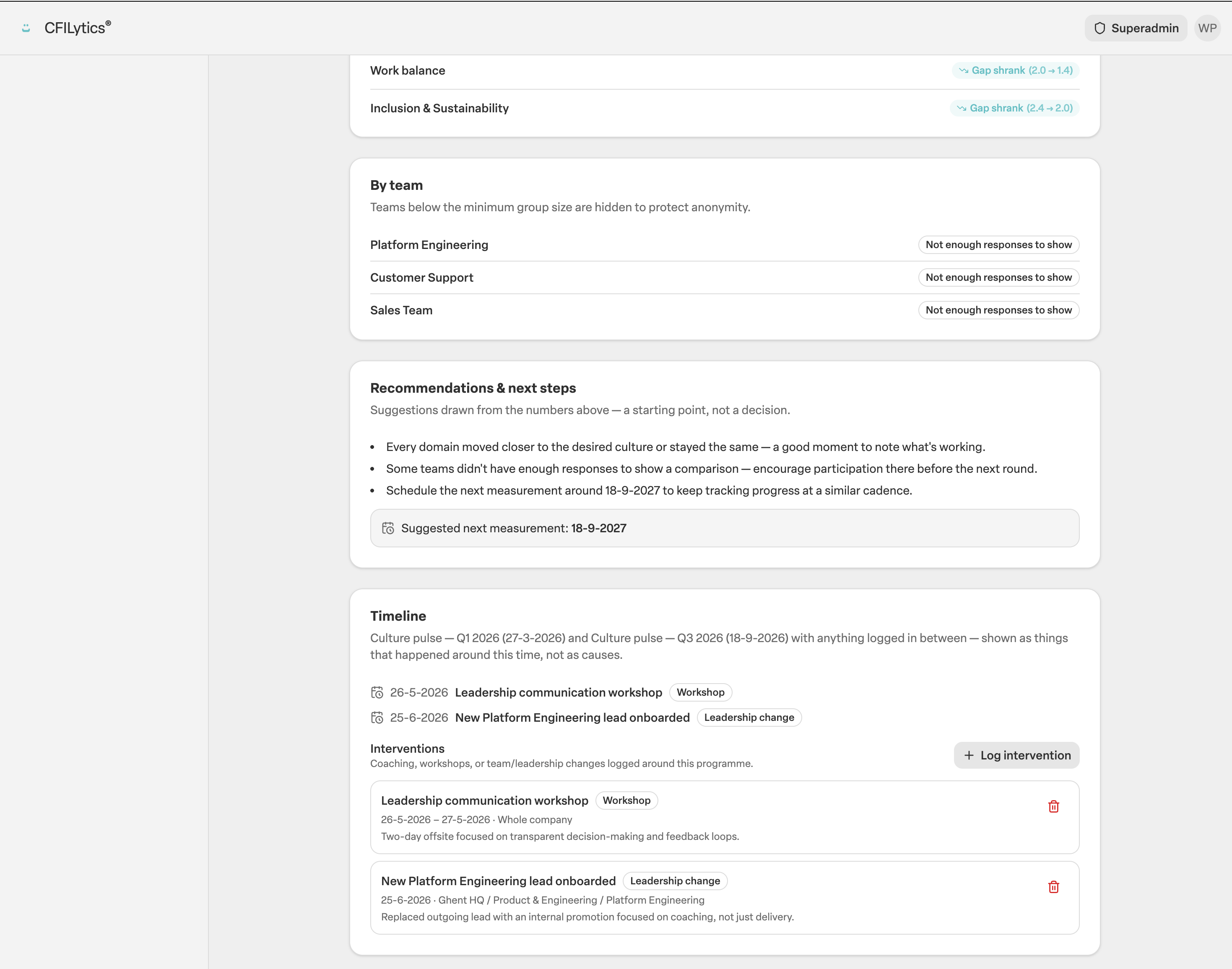
Did anything change?
Two measurements side by side, with workshops and leadership changes logged in between. Shown as things that happened around the same time, not as causes.
In anonymous campaigns, teams with fewer than five respondents stay hidden.
Method, not magic.
CFILytics® measures the deepest layer of Edgar Schein's culture model: the basic underlying assumptions. The things people take for granted, and rarely say out loud.
Developed with Sapience, a spin-off of the Vrije Universiteit Brussel (VUB). The model is described in the book De Architectuur van Bedrijfscultuur (Pelgrims & Desmet, 2026).
- Deterministic scoring. The same answers always give the same result. No black box.
- Distance, not labels. Profiles are compared with Euclidean distance over all statements. You can give a domain more weight; nothing is left out.
- Anonymous when you want it. You choose per campaign whether employees answer anonymously or by name. Anonymous group results appear from 5 respondents.
- No automated decisions. The tool informs. A person decides.
- GDPR and EU AI Act. Candidate data is kept for 365 days.
Built for people who advise and decide.
Before the deal
Cultural due diligence. Compare two organisations on the same seven domains before integration starts.
Mergers & acquisitions OrganisationsToday versus tomorrow
Compare today's culture with the culture management wants. See where teams, departments and locations differ.
Organisations ConsultantsA measurement, not an impression
Run campaigns for your clients. Discuss the report together and follow up with a second measurement.
ConsultantsRecruiters and HR teams use it to compare a candidate with the team they would join. As input for the conversation, never as a reason to reject.
Three steps.
-
Invite
Create a campaign for candidates, employees or management. Each person receives a link.
-
Answer
An 8-minute chat with statements, answered on a 7-point scale.
-
Compare
The app calculates the distance between two profiles. You see matches, gaps and a prioritised action plan.
Before you start.
Is this a personality test?
Is it validated?
Can someone be rejected based on the result?
Are employee answers anonymous?
Is it fair to candidates?
Does it use AI?
What does it cost?
How long does it take to answer?
Start with your own team.
Your first 10 measurements are free. Run a pilot with one team, this month.