
Cultural due diligence before the deal.
Two organisations, one scale. See where they match, where they differ, and what integration will ask of both sides. Before you sign.
Illustrative data. Two large gaps, one match. That is where integration work starts.
Culture is in every deal memo.
Rarely in the data room.
Financial, legal and commercial due diligence come with numbers.
Culture comes with a paragraph.
Interviews are not a measurement
A few conversations with the management team give an impression of the culture at the top. They say little about the teams that have to work together after closing.
The gap surfaces after signing
Two ways of leading, deciding and communicating meet for the first time during integration. By then the price is paid and the plan is written.
Integration stalls
Key people leave. Teams keep working the way they always did. The synergies stay on paper. Culture is named as the cause, after the fact.
Both organisations.
Same statements.
Same scale.
Employees and management on both sides answer the same 8-minute chat. The result is two profiles on seven domains, and the distance between them.
Buyer versus target
The whole organisation, or the sites and departments that will actually merge. You choose the level of detail.
Today versus the culture you want
Management on both sides describes the desired culture. See whether the two leadership teams agree, before they have to lead together.
Match and gap per domain
One match percentage, and the seven domains ranked by distance. The largest gaps are your integration agenda.
What the report shows.
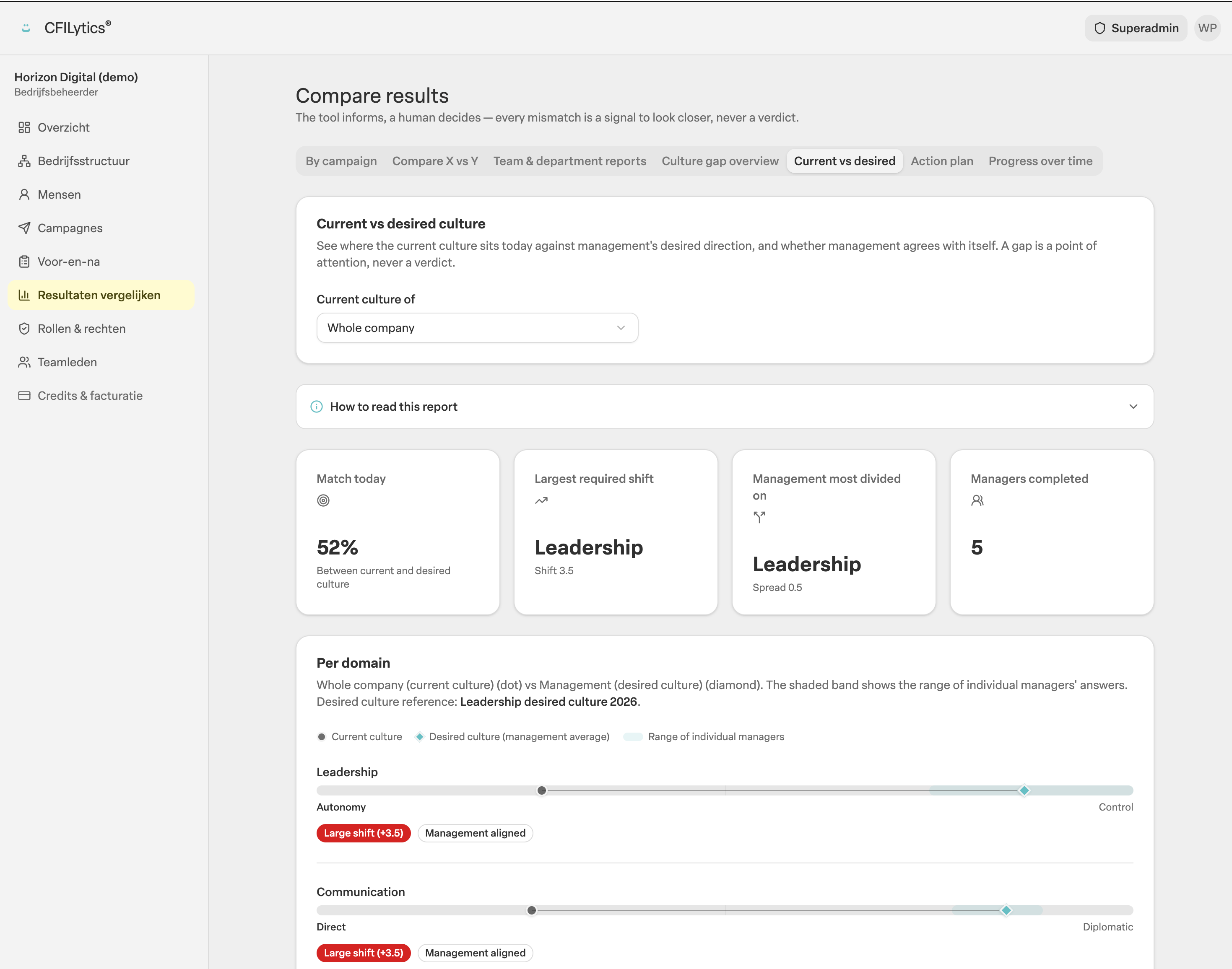
Two profiles, side by side.
Per domain you see where each organisation sits between the two poles, and how far apart they are. The shaded band shows how divided a management team is among itself.
Compare buyer and target, site and site, or the management teams of both. Demo data from a fictional company.
Method, not magic.
Advisers and investment committees need a method they can defend. Not a personality test with a colour.
Based on Edgar Schein's basic underlying assumptions. Developed with Sapience, a spin-off of the Vrije Universiteit Brussel (VUB). Described in the book De Architectuur van Bedrijfscultuur (Pelgrims & Desmet, 2026).

- Deterministic scoring. The same answers always give the same result. No black box.
- Distance, not labels. Profiles are compared with Euclidean distance over all statements. Nothing is left out.
- Anonymous when you want it. You choose per campaign. Anonymous group results appear from 5 respondents.
- No automated decisions. The tool informs. A person decides.
- GDPR and EU AI Act. Candidate data is kept for 365 days.
Four steps, inside the due diligence window.
Set up both sides
Two organisations in one workspace, with the teams, departments and locations that matter for the deal. The target's data stays separate.
Invite
Employees answer anonymously. A group result only appears from 5 respondents. Management on both sides describes the desired culture.
Compare
Match and gap per domain, for the whole organisation or per site. Usually within two weeks of the first invitation.
Decide, then plan
The action plan ranks the gaps by size and people affected. It becomes the culture chapter of the integration plan.
Start free. Then pay for what you measure.
A due diligence is a culture campaign on both sides. Priced per campaign, all reports included.
10 measurements free
One measurement is one completed questionnaire. No card needed.
Start freePer candidate
Compare a candidate with the team, or with the culture you want. Priced per candidate.
See pricingPer campaign
Employees, management or both. All reports included. Priced per campaign, not per person.
See pricingBefore you start.
Can we measure the target under confidentiality?
How long does it take?
What if the target has small teams?
Is a large gap a reason to walk away?
Know the culture before you buy it.
Your first 10 measurements are free. Run a pilot on one site.